Artificial Intelligence(AI) is everywhere right now. Best to embrace it.
Depending on who you listen to, AI is either going to solve every problem humanity has ever created, destroy civilization before lunch next Tuesday, eliminate every job, create millions of new jobs, make everybody rich, make everybody poor, or generate a picture of a cat wearing a cowboy hat. Probably all before the end of the week.
The amount of hype makes it easy to dismiss the whole thing. We have been told for decades that some new technology was going to “change everything.” Sometimes it did. Sometimes it gave us a refrigerator with a touchscreen that takes longer to start than the refrigerator takes to make ice. AI is different, not because every prediction about it will come true, but because AI is not merely another device, application, or website. It is becoming a general purpose layer of mental labor. That sounds dramatic. It is also becoming one of the less dramatic ways to describe what is happening. We keep treating AI like an application we may or may not choose to install. It is closer to electricity, computing, or the internet: something that gradually works its way underneath nearly every other technology, business, profession, and workflow.
You may choose never to open an AI chatbot. That does not mean AI will choose to leave you alone.
Exponential Growth Is Boring Until It Isn’t
People are generally comfortable thinking in straight lines. If I walk one mile today, two miles tomorrow, and three miles the next day, I can look at the pattern and make a reasonable guess about where I will be next week. That is linear growth. We add roughly the same amount each time. Exponential growth behaves differently. Instead of adding, it multiplies. One becomes two. Two becomes four. Four becomes eight. Eight becomes sixteen. At first, this is not very exciting. The early part of an exponential curve looks like a teenager getting out of bed on Saturday morning. Technically, movement is occurring, but nobody is impressed. Then the curve bends upward. The first half looks like the technology is moving slowly. The second half looks like somebody cheated.
A long running observation about computer chips showed this pattern for decades. Roughly every couple of years, manufacturers managed to fit far more computing power into a similar amount of space and cost. That steady compounding helped move us from computers that occupied rooms to computers we carry around while complaining that the restaurant’s website loaded slowly.
AI has recently been growing at a much steeper rate. Statistics tracking important AI systems estimate that the amount of computing used to create them has been multiplying several times per year since 2010. Roughly doubling about every six months. That is exponential growth!
However, something even more important may now be happening: the rate of improvement itself appears to be accelerating.
A study found that the measured pace of improvement in leading AI systems became about 1.85 times faster around 2024. The exact number should not be treated like it was engraved on a stone tablet and handed down from the mountain. Measuring “intelligence” is messy. Still, several different measurements point in the same general direction.
In other words, the car is not only traveling faster. Someone may still be pressing the accelerator to the floor.
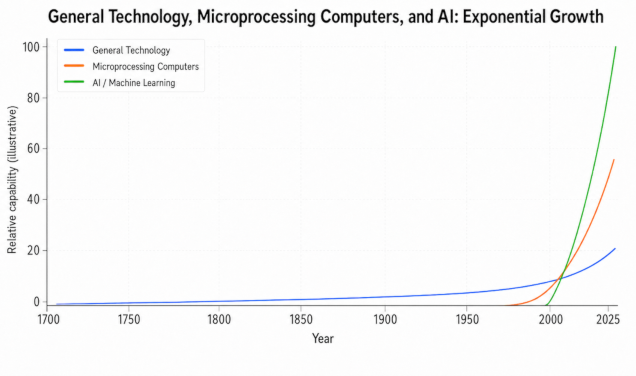
In the chart above, the left side compares the long term growth of general technology (like steam engines, the plow, etc...) with the much steeper recent growth of computers and then AI. The right side shows evidence that the rate of AI improvement has itself increased.
The chart uses "technology" as a general baseline. Computing has been one of the main engines underneath modern technology and it's growth has been exponential compared to general technology. And AI is now compounding exponentially on top of all that previous progress.
This creates a stacking effect:
- Better chips help us build better AI.
- Better AI helps engineers design better software and hardware.
- Better software and hardware improves the tools used to build the next generation of AI.
- Better AI assists the researchers trying to improve AI itself.
This iteration is not occurring over a decade or a year, but monthly.
The tool is beginning to participate in building the next version of the tool. It is a little like giving the carpenter a hammer that reads woodworking books at night and arrives the next morning with suggestions for a better hammer. That feedback loop is a major reason AI feels different from many earlier technologies.
We Have Resisted Every Major Technology
Human beings have an impressive ability to adapt to new technology. We also have an impressive ability to complain about it first.
- Electricity was dangerous and unnecessary.
- Automobiles were noisy machines that frightened horses.
- Radio would ruin conversation.
- Television would rot everybody’s brain.
- Automated teller machines would eliminate bank tellers.
- Personal computers were expensive toys.
- The internet was mostly for academics, government workers, and weird people.
- Online shopping would never replace visiting a store.
- Smartphones were unnecessary because we already had phones and computers.
Some of the concerns were valid. New technologies do create new risks, eliminate certain jobs, disrupt established institutions, concentrate power, and produce consequences nobody predicted. The mistake is assuming that resistance prevents adoption. It usually does not. A technology does not need everybody’s permission to become normal. It only needs to become useful enough that businesses, governments, competitors, and ordinary people are rewarded for using it. Once that happens, not adopting it becomes a decision with a cost.
The pattern usually looks something like this:
- The technology appears.
- Enthusiasts exaggerate what it can do.
- Skeptics exaggerate why it will fail.
- The technology quietly improves while everybody argues.
- Businesses discover practical uses.
- The technology becomes infrastructure.
- Everybody forgets that they once considered it optional.
AI is currently somewhere in the middle of that list, and it is moving through the list fairly quickly.
“AI Will Not Affect Me”
Many people think:
“I don’t use AI.”
“My job has nothing to do with computers.”
“I’m too close to retirement.”
“My customers want to deal with a real person.”
“My business is different.”
“I work with my hands.”
“I’m not a programmer.”
"I don't have time to think about that crap."
All may be true. However, they do not describe how AI will interact with the systems surrounding that person that will affect them. Most people do not personally operate the computer systems used by banks, insurers, hospitals, retailers, delivery companies, employers, government agencies, and cybersecurity teams. Those systems still influence their lives.
AI will affect:
- Which job applications are reviewed.
- How fraud is detected.
- How products are priced and recommended.
- How customer service requests are routed.
- How the software used at work is created.
- How medical information is analyzed.
- How medical insurance coverage is determined.
- How traffic, deliveries, inventory, and schedules are managed.
- How scams and cyberattacks are created and how they are detected.
- How businesses decide which tasks require a person.
- How laws are written and enforced.
You don't need to personally use a technology for it to alter the economy, infrastructure, and resources around you.
A farmer in 1925 did not need to own an automobile for roads, trucking, supermarkets, and suburban development to change the market in which the farmer operated.
A retail employee in 1995 did not need to use the internet for online commerce to eventually alter the number, location, and purpose of physical stores.
Saying “I do not use AI” may soon be a little like saying “I do not use electricity” while standing in an air conditioned grocery store paying with a credit card. AI may eventually become the most influential technology ever developed because it is not limited to improving one physical task. It can be applied to portions of nearly every task involving language, prediction, classification, planning, pattern recognition, analysis, design, communication, or decision support. That covers a disturbingly large percentage of civilization. Not to mention to exploding development of robotics. Start deciding on what color you want your C3P0. You will probably be choosing within the next decade. Possibly sooner.
AI Was Helping Science Before It Was Writing Poems
Generative AI, one example being "ChatGPT", has caused many people to associate AI with chatbots and image generators. Those are simply the most visible forms. Machine learning has been assisting scientific work for decades. Researchers were using pattern recognition systems in areas such as particle physics long before the public was asking chatbots to write wedding speeches or to generate pictures of historical figures taking selfies.
"Traditional software" works best when a programmer can clearly define the rules.
For example:
IF temperature is below 32 degrees
AND precipitation is occurring
THEN precipitation may be snow
Machine learning becomes valuable when the rules are too numerous, subtle, noisy, or complicated to write manually. Instead of explaining every rule, researchers provide examples and allow the computer to find useful patterns.
Imagine trying to teach someone to recognize a dog. You could attempt to write rules:
- Usually has four legs.
- Usually has fur.
- Often has a tail.
- Frequently looks guilty when standing near a shredded couch cushion.
The problem is that cats also have fur and four legs. Some dogs have very little hair. Some are missing a leg. A wolf may look more like a dog than a tiny dog wearing a sweater. Writing every possible rule becomes difficult very quickly.
A machine learning system takes another approach: show it many examples of dogs and non-dogs, and let it learn which combinations of features tend to matter. And has been used for:
- Detecting patterns in medical images.
- Classifying objects in space.
- Finding unusual events in scientific experiments.
- Predicting how molecules may behave.
- Improving weather forecasts.
- Analyzing genetic information.
- Identifying promising drug candidates.
- Controlling complex experiments.
- Detecting signals that may be almost invisible to a person.
An AI model demonstrated how powerful this can become by predicting the shapes of proteins, a problem scientists had worked on for decades. Protein shape matters because the shape helps determine what the protein does. A useful analogy is trying to understand a complicated tool when it is folded inside a locked suitcase. Predicting the folded shape helps researchers understand what the tool may be capable of doing.
Another AI model produced global weather forecasts much faster than traditional methods while outperforming a leading forecasting system across many measurements.
At a major research facility, machine learning models have also been used to estimate the likelihood of successful fusion experiments before the actual experiment is performed. Considering the expense and complexity involved, that is slightly more useful than checking whether your fantasy football lineup looks promising.
AI did not suddenly become useful when it learned to talk. It simply became easier for ordinary people to notice.
From *Assisting* Software Developers to *Becoming* Software Developers
Software development is one of the clearest examples of how AI adoption progresses.
Initially, AI assisted with small tasks:
- Completing a line of code.
- Looking up documentation.
- Explaining an error.
- Writing a regular expression that no sane person wanted to write manually.
- Generating a basic function.
- Translating code from one programming language to another.
Then it began working with larger pieces:
- Reviewing several files.
- Adding tests.
- Reorganizing existing code.
- Finding bugs.
- Updating dependencies.
- Preparing database changes.
- Explaining unfamiliar projects.
- Implementing a feature from a written description.
Now coding "AI agents"" can inspect an entire project, search files, edit code, execute commands, run tests, observe failures, revise their work, and continue until a goal is met, or until they confidently turn the project into a decorative pile of configuration files.
A benchmark now tests AI systems using real problems from real software projects rather than small isolated programming puzzles.
A separate set of measurements tracks how long a task can take a skilled person while still being completed successfully by an AI system at a given rate. The trend has been rising quickly, especially on software related work. The researchers are careful to point out that benchmark tasks are usually cleaner than real jobs.
That warning matters! Because real jobs include unclear instructions, missing information, conflicting priorities, old systems, office politics, budget limits, and someone named Bob who changed the spreadsheet formula three years ago and does not remember why.
The transition is not:
Monday: Human software developers
Tuesday: No human software developers
It looks more like this:
Developer writes every line.
        ↓
AI completes individual lines.
        ↓
AI drafts functions.
        ↓
AI modifies several files.
        ↓
AI implements limited features.
        ↓
AI agents perform tasks while developers review.
        ↓
Multiple agents implement, test, review, document, and deploy.
        ↓
Humans increasingly define goals, constraints, architecture, and approval.
The human developer gradually moves from manually producing every line to defining what should be built, giving the AI the right information, reviewing its decisions, validating the result, and accepting responsibility for the outcome. That is still software development. It is simply software development at a different level. The calculator did not eliminate mathematics. It changed which calculations people performed manually. Compilers did not eliminate programming. They allowed developers to stop entering machine instructions one at a time like monks copying manuscripts, except with more coffee and less job security.
AI will probably not eliminate the need for people who understand software. It may severely reduce the value of merely being able to "type software".
Workflow Is the Real Battlefield
People often ask whether AI can perform a particular job. That is usually the wrong unit of measurement. A job is a bundle of tasks wearing a polo shirt and a job title.
An administrative assistant may:
- Read email.
- Schedule meetings.
- Prepare documents.
- Enter information.
- Answer questions.
- Route requests.
- Follow up with people.
- Handle unusual exceptions.
- Calm down an angry caller.
- Notice that the boss has forgotten something important.
AI may be excellent at some of these, mediocre at others, and completely inappropriate for a few. Automation therefore arrives task by task.
A way to think about the progression is:
Stage 1: AI Assists the Human
The person performs the workflow. "AI agent" drafts, summarizes, searches, recommends, or checks.
This is like having an intern who works extremely fast, has read an unreasonable amount, and occasionally invents a fact with the confidence of a man at a cookout explaining barbecue to the person who owns the smoker. Useful, but supervision is recommended.
Stage 2: AI Performs Individual Steps
The person delegates limited tasks, reviews the output, and moves the process forward.
For example, an "AI agent" may read a group of documents and prepare a summary, while the person checks the conclusions and decides what happens next.
Stage 3: AI Coordinates Several Steps
An "AI agent"" reads a request, chooses tools, gathers information, generates output, checks results, and asks for approval when necessary.
The person is no longer pressing every button. The person is supervising a process.
Stage 4: AI Operates Most of the Workflow
The person handles unusual situations, approves high impact actions, and remains accountable.
This is similar to an airplane’s autopilot. The automation may handle a large portion of normal operation, but everybody still wants a qualified person available when the weather gets ugly and the dashboard starts making expensive noises.
Stage 5: The Workflow Is Redesigned Around AI
This is the stage people often overlook or don't consider.
Businesses do not just replace each human action with a robot shaped version of the same action. Once the technology becomes capable enough, the process itself changes. Digital photography did not simply replace film inside the same camera stores. It largely eliminated film development as a routine consumer workflow. Email did not merely make postal mail faster. It changed the volume, speed, structure, and expectations of business communication. Online banking did not just move a teller behind a website. It allowed transactions to happen at times and in ways that would have been impractical with a person involved in every step.
AI will do the same thing.
The largest effects may not come from inserting AI into existing workflows. They may come from creating workflows that would have been too expensive, too slow, or simply impossible when every step required human attention.
The Gradual Replacement That Will Feel Sudden
The phrase “AI will replace humans” creates an image of millions of people being simultaneously escorted from their jobs by chrome plated robots saying "Owl be bock." That is unlikely. The more realistic process will be gradual(but not as gradual as prior new technologies), uneven, and difficult to see while it is happening.
A company may avoid filling a vacant position because existing employees now accomplish more with AI. A department that once needed ten people may need eight. A new company may serve the same number of customers with one fourth the staff of an older competitor. An employee may keep the same title but spend less time producing work and more time reviewing automated work. A profession may continue to exist while the number of entry level positions shrinks. A single person using several AI agents may perform work that previously required a small team. None of these events looks like “AI replaced everybody.” Combined across thousands of organizations and several years, they become a major change in how work is organized.
Statistics estimate that roughly one in four workers worldwide is in an occupation with at least some exposure to generative AI. The same research suggests that, in the near term, more jobs are likely to be changed than completely erased because many tasks still require human input.
Jobs will often be transformed before they are eliminated.
In the near future, expect:
- AI assistance to become a normal feature inside ordinary software.
- More emails, reports, code, images, and analyses to begin as AI generated drafts.
- Agents to handle well defined processes across several applications.
- Humans to approve financial, legal, safety related, or irreversible actions.
- Smaller teams to produce output that previously required much larger groups.
- Employers to value people who can supervise and verify AI generated work.
- Entry level jobs based mostly on routine production to face pressure.
- New jobs involving AI integration, evaluation, security, policy, and workflow design.
Farther into the future, we *will* see:
- "AI Agents" that operate continuously rather than waiting for individual prompts.
- Personal "AI Agent" systems that maintain useful context across projects and years.
- Businesses in which much of the routine operational work is executed by software "AI agents".
- Robots connecting AI’s digital abilities to the physical world.
- Increasing automation of research, engineering, administration, logistics, and manufacturing.
- Human labor concentrating around goals, judgment, relationships, accountability, taste, trust, and unusual situations.
- Entirely new forms of work that are difficult to imagine from today’s perspective.
This will not happen evenly:
Installing an "AI agent" in a software environment is easier than installing a robot in every attic, crawlspace, kitchen, construction site, hospital room, and flooded ditch. The physical world is messy. People are messy. Organizations are exceptionally messy. Anyone who has tried to get three departments to agree on the name of a shared folder understands that complete automation may encounter some resistance. That friction matters. It slows the transition, but it does not stop it.
What Is a Large Language Model(LLM)?
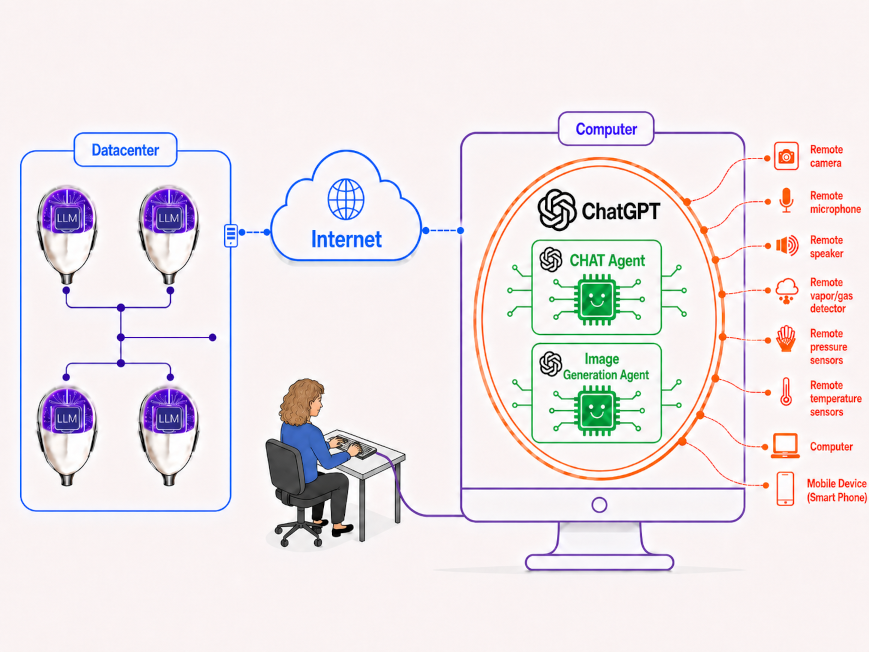
A Large Language Model(LLM) is the AI brain behind most modern chatbots, coding assistants, and "AI agents". The name sounds more complicated than the basic idea. Key in on the "Language" part of the Large Language Model. A language model is trained to recognize patterns in language and predict what should come next.
Given:
The quick brown fox jumps over the lazy...It will probably predict:
dogThat sounds unimpressive. Autocomplete has existed for years. The difference is scale.
A modern LLM has trained on an enormous number of examples(think in terms of trillions of examples). Those examples may include books, articles, websites, manuals, conversations, research papers, and source code. From that training, it learns relationships between words, ideas, writing styles, facts, instructions, and common ways of solving problems. To put that into perspective, consider this:
- You have not forgotten ANYTHING from your conception that you have heard, seen, felt, smelled, tasted, or thought about.
- You have read every book that has every been published.
- You have read every page of every website that has ever existed on the internet. And looked at every image on every page.
- You have listened to or read a transcript of every publicly available conversation.
- You have been given access to millions of articles, manuals, research papers and you read all of them.
- You have been given trillions of lines of source code and you read every line.
- You REMEMBER ALL OF IT.
- You were given billions of "opinions" (weights) to use when you think through all that you learned.
Now you are not only the smartest human that ever lived, but you are also an LLM.
An LLM does not simply memorize one giant answer sheet. It builds a huge web of mathematical relationships. A useful way to picture it is a person who has spent years reading in a library but instead of remembering every page perfectly, the reading has changed billions of tiny connections in the person’s mind.
The LLM learns things such as:
- Which words tend to appear together.
- How sentences are structured.
- Which concepts are related.
- How explanations are usually organized.
- What computer code tends to look like.
- How questions are commonly answered.
- Which ideas often follow other ideas.
The result is a prediction machine with an unimaginable broad education and absolutely no childhood. It can explain grief but has never lost anyone. It can describe a broken ankle but has never stepped off a curb badly. It can write a restaurant review but has never tasted a french fry. That difference is important.
Tokens: The Pieces of Language
LLMs do not usually read text one full word at a time. They divide text into smaller pieces called tokens.
A token may be:
- A whole common word.
- Part of a longer word.
- Punctuation.
- A number.
- A piece of computer code.
- A space attached to nearby letters.
Tokens are a little like LEGO pieces for language. Common words may be represented by one larger piece. Less common words may be assembled from several smaller pieces. The LLM reads the pieces already provided, estimates which piece should come next, adds it, and repeats the process. It is doing this very quickly(a bazillion times a second), which is fortunate because watching it choose one tiny piece every few seconds would make paint drying look like an action movie.
Parameters: Billions of Tiny Adjustments
Inside a LLM are billions(or in some cases 100x that) of adjustable numbers called parameters. That term is important, but it does not need to be mysterious. Think of that "equalizer" in your car stereo(that you probably have never even adjusted). It has those 5 or 10 "bars" for adjusting the sound frequencies to the way you want to hear your music. Now imagine an "equalizer" with billions of tiny "bars". Each "bar" makes an almost meaningless adjustment by itself. Together, they shape the final sound of your music. So, those "bars" are parameters.
During training, the LLM tries to predict missing or upcoming text. When it predicts badly, the training process(mathematical side programs) adjusts many of those "bars" slightly. Then it tries again. And again. And again. An almost unimaginable amount of times. This happens across enormous amounts of material using vast amounts of computing power(which you may have heard or read as "AI Data Centers"). No human programmer manually labels one knob “knows Shakespeare” and another “understands tax forms.” Useful abilities, or "ways of thinking", emerge from the combined pattern of all those parameter adjustments.
Attention: What Matters Right Now?
A major breakthrough described in a research paper helped LLM's become much better at deciding which earlier parts of a passage matter to the current word or idea.
Consider this sentence:
John gave the laptop to Sarah because she needed it.To understand “she,” the LLM needs to connect it with “Sarah.”
To understand “it,” the LLM needs to connect it with “laptop.”
That ability is often called attention.
Finally a name that doesn't really need an analogy! We should appreciate it before somebody renames it "Neural Contextual Hyper Relevance Fabric 2.0".
The Context Window: The Model’s Workbench
The context window is the amount of information the LLM can consider at one time.
Think of it as a workbench. A small workbench may hold the current question and a page of instructions. A large workbench may hold a long conversation, several documents, examples, notes, and source code. A larger bench is useful, but it does not guarantee good work. You can cover an entire dining room table with tax documents and still lose the one form you need. The model may have access to the right information and still focus on the wrong part, misunderstand it, or make a bad connection. This is one reason AI can be impressive one moment and baffling the next.
How an LLM Is Created
The exact process differs from one LLM to another, but the broad steps are understandable without a degree in mathematics or a basement full of graphics cards.
1. Gather and Prepare the Material
Training material may include:
- Books.
- Websites.
- Documentation.
- Research papers.
- Source code.
- Reference material.
- Licensed information.
- Examples written by people.
- Examples generated by other AI systems(this is the crazy exponential growth evolution in play).
The material must be filtered, cleaned, sorted, and converted into a form the "training system" can use.
2. Send the LLM to School
During the main training stage, the LLM repeatedly tries to predict missing or upcoming text. At the beginning, its predictions are terrible. This is expected. Nobody is born knowing where to place a semicolon, including a surprising number of people who use semicolons professionally. Each mistake causes tiny changes to the LLM’s internal numbers. Across a huge number of examples, it gradually becomes better at recognizing language, concepts, patterns, and common ways of reasoning. This stage is where the LLM gains much of its broad ability. It can require thousands of specialized computer chips operating for weeks or months.
3. Teach It to Follow Instructions
A raw LLM is mainly trained to continue text. That does not automatically make it a useful assistant.
Suppose you write:
Explain photosynthesis.A raw LLM might continue with:
Explain cellular respiration.It continued the pattern instead of answering the request.
Additional training gives it examples of instructions and good responses. This helps the LLM learn that a question should usually be answered, a requested format should be followed, and “summarize this” does not mean “write a second document twice as long.”
A well known study showed how examples, human preferences, and additional training could make a LLM substantially more useful as an assistant.
4. Show It Which Answers People Prefer
People may compare several possible answers and identify which are more helpful, clear, safe, or accurate. The LLM can then be adjusted toward the preferred style of response.
Modern training may also use automated checks, AI generated critiques, rule based feedback, verified answers, and other methods. This process does not make the LLM perfect. It makes the LLM more likely to behave in a useful way.
There is a difference. Similar to the difference between teaching a teenager how to drive and receiving a written guarantee that the mailbox will survive.
5. Test It
LLM's are tested in areas such as:
- General knowledge.
- Mathematics.
- Programming.
- Reasoning.
- Following instructions.
- Safety.
- Tool use.
- Reading long documents.
- Resistance to misleading instructions.
- Reliability in unusual situations.
Tests are useful, but tests are not reality. A LLM scoring well on an exam does not guarantee that it can safely manage payroll, configure a firewall, diagnose a patient, or modify a production database. We have all met people who scored well on exams, but... That is all I am going to say about that.
6. Prepare It to Run
The completed LLM may be compressed, adjusted for different types of hardware, or split across multiple servers/processors. Something to consider is that this completed LLM is literally a "file"(or in some cases multiple files). The LLM itself is not "hardware", it is "software". Think as if you could "download" everything from your brain as a file. Then your "brain model" file could be uploaded into someone else's brain.
Very large LLM's may run in enormous data centers. Smaller or compressed versions can run on business servers, workstations, laptops, phones, and other local devices.
7. Make It Available for Inference
Training is the process of creating or changing the LLM. Inference is the process of using it.
Training is school. Inference is the LLM clocking in for work.
During inference, the LLM receives a request and whatever supporting information is provided. It processes that information using what it learned during training and generates a response piece by piece. It usually is not permanently retraining itself during every conversation. Telling a chatbot that your neighbor’s dog is named Coochie does not normally alter the underlying model for the entire planet. Coochie can relax.
An LLM Is Similar to a Brain. But It Is Not a Brain
Comparing an LLM with the human brain is useful as long as we remember that it is an analogy, not a biological claim. Both contain large networks of connections whose strengths influence what happens next. Both learn patterns from exposure. Both can make connections between ideas. Both use context. Both can produce confident mistakes. That last one should make everybody feel better. Or worse.
However, important differences remain.
A human brain:
- Has a body.
- Receives a constant stream of sights, sounds, smells, touch, and other sensations.
- Develops through lived experience.
- Has biological needs and drives.
- Maintains an ongoing personal identity.
- Learns continuously from the physical and social world.
- Experiences consequences.
- Remembers events in ways that differ greatly from model context.
- May possess consciousness, although humans are still arguing about exactly what that means.
A basic LLM has none of those things by itself, it:
- sits motionless until information is provided.
- cannot see unless connected to a camera or image system.
- cannot hear unless connected to audio.
- cannot access a file unless something gives it permission.
- cannot remember last week unless information was saved and provided again.
- cannot act in the world merely because it generated a sentence describing an action.
An LLM alone is somewhat like a brain floating in a sealed container. Potentially intelligent. Not especially useful. Also a terrible centerpiece for the dining room table. This is where agents and harnesses enter the picture.
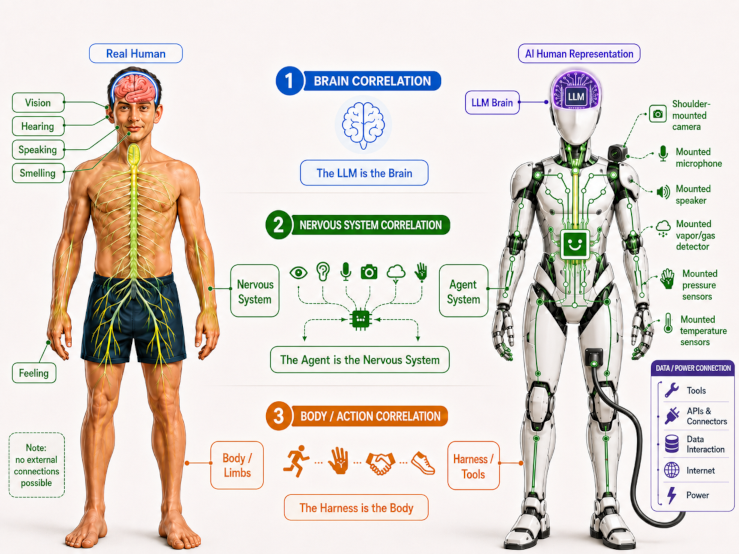
The LLM Is the Brain
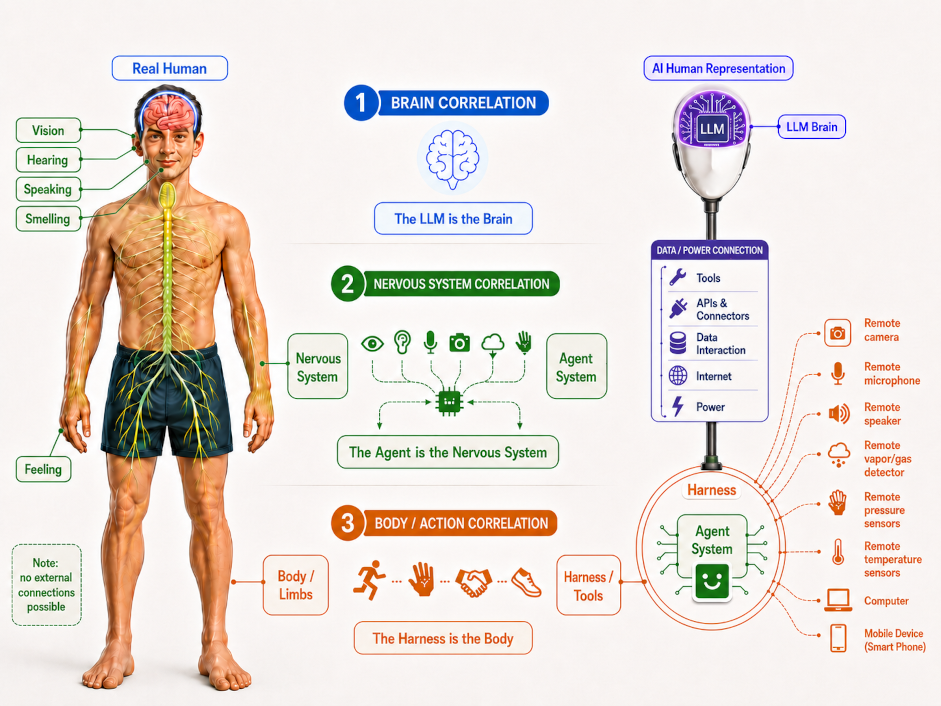
The LLM("brain") performs the core language and reasoning work.
It interprets instructions, examines available information, proposes actions, evaluates results, and generates output.
Different models have different strengths. One may be excellent at programming. Another may be better at writing. Another may be faster and cheaper. Another may reason more carefully but require substantially more computing power.
The LLM is the part that “thinks” in our analogy although quotation marks should remain firmly attached to that word.
The Agent Is the Nervous System
An agent connects the model to sources of information and allows it to operate in a repeating loop.
A simplified agent loop looks like this:
Observe what is happening
        ↓
Decide what to do next
        ↓
Use a tool
        ↓
Read the result
        ↓
Adjust the plan
        ↓
Repeat
The agent’s tools act like senses and communication channels.
- A camera or screenshot tool provides vision.
- A microphone provides hearing.
- A voice system allows it to speak.
- A browser allows it to interact with websites.
- A search tool helps it find information.
- An email tool allows it to communicate.
- A database tool allows it to read and store structured information.
- Physical sensors provide temperature, location, pressure, motion, or other measurements.
- Connections to business systems act like specialized nerves reaching into different parts of an organization.
Without tools, the LLM can only respond using what it learned previously and what is included in the current request. An agent without tools is a smart person locked in an empty room. It may have excellent ideas, but it cannot check the weather, open the door, send an email, or confirm whether accounting finally approved the purchase order.
A company’s explanation draws a useful distinction between a fixed workflow, where software determines the steps in advance, and a more independent agent, where the LLM decides which steps and tools are needed as the work unfolds.
The terminology is not perfectly standardized. Different companies use “agent,” “assistant,” “workflow,” “orchestrator,” and “copilot” for overlapping ideas. Welcome to technology, where naming things clearly is apparently considered a sign of weakness.
The Harness Is the Body
The harness is the working environment built around the LLM and agent.
“Harness” is one of those terms that sounds more mysterious than it is. Think of it as everything that gives the LLM and AI agent a safe place to work and the ability to interact with the outside world.
Depending on the system, a harness may include:
- Tools.
- Access to files.
- A command line.
- A web browser.
- Memory.
- Databases.
- Connections to other software.
- Permissions.
- Safety restrictions.
- Logs of what happened.
- Testing.
- Retry rules.
- Approval steps.
- Multiple specialized agents.
- A queue of tasks.
- Ways to recover when something fails.
In the human body analogy, the harness is the skeleton, muscles, arms, hands, legs, and feet.
- The brain may decide to pick up a cup.
- The nervous system carries the signal.
- The arm and hand interact with the physical world.
For a coding agent:
- The LLM decides that a file needs to change.
- The agent selects the file editing tool.
- The harness gives that tool controlled access to the project.
- The file is changed.
- Tests are run.
- The LLM reviews the results.
- The loop continues.
For an administrative agent:
- The LLM interprets an emailed request.
- The agent checks a calendar.
- harness provides authorized calendar access.
- The agent proposes an available time.
- A person approves the action.
- The harness sends the invitation and records what happened.
A capable LLM with a poor harness may perform badly.
A smaller LLM provided with excellent tools, clear instructions, good memory, and strong checks may outperform a larger LLM on a specific job.
A harness without a capable LLM is a forklift with nobody driving.
A capable LLM without a harness is a driver with no vehicle.
And a capable LLM with a powerful harness but no permissions or safety controls is the reason the security department drinks.
Agents Are Evolving Quickly
The first popular AI "chatbots" followed a simple pattern:
Person asks question.
LLM answers question.
Conversation ends.
Agents add persistence and action.
A agent, under the direction of an LLM, may:
- Receive a goal.
- Break the goal into smaller tasks.
- Search for relevant information.
- Read files.
- Write or modify content.
- Execute commands.
- Test its work.
- Detect a failure.
- Revise the plan.
- Ask another specialized agent for review.
- Request human approval.
- Complete the action.
- Record the result for future use.
Modern agent frameworks increasingly provide tool use, memory, handoffs between agents, safety rules, approval steps, and detailed records of what the system did. This is the difference between asking AI how to perform a task and assigning AI the task.
For example:
Chatbot:
“Here are the commands you can use to update the server.”

Agent:
“I reviewed the server, created a backup, prepared a proposed change,
tested it in a safe environment, found one compatibility problem,
corrected it, and am waiting for approval before applying the final change.”
The second example requires far more than an LLM. It requires tools, permissions, memory, safety controls, testing, and a carefully designed harness. It also requires somebody to remain responsible when the agent decides that “cleaning up old files” includes the production database.
Automation Happens When the Pieces Come Together
An LLM can reason about information.
Tools provide access to information and actions.
An agent coordinates the reasoning and actions.
A harness provides the working environment.
Memory preserves useful information.
Multiple agents provide specialization.
Robotics connects the digital system to the physical world.
When these pieces are combined, AI stops being only a chatbot and starts becoming an automated worker.
Consider a purchasing workflow.
A sufficiently connected system could:
- Monitor inventory.
- Predict future demand.
- Notice that supplies are running low.
- Check approved vendors.
- Request current pricing.
- Compare quotes.
- Review contract requirements.
- Prepare a purchase request.
- Route it for approval.
- Submit the approved order.
- Track delivery.
- Match the invoice against the order.
- Flag differences.
- Update financial records.
- Produce an audit trail.
Today, separate people and separate software systems may perform these steps. Eventually, an agent may coordinate most of them while people handle policy, approval, exceptions, negotiation, relationships, and accountability. The final step in automation is not making AI better at chatting. It is connecting the intelligence to the systems where work actually occurs.
A brilliant chatbot that cannot access the right information or perform an action is like hiring a world class mechanic, giving him no tools, and parking the car in another state.
Hardware Is the Most Physical Brake
AI improvement/evolution may feel purely digital, but it depends on a very physical industrial system.
Advanced AI requires:
- Semiconductor factories.
- Specialized computer chips.
- Extremely fast memory.
- Complicated chip packaging.
- Networking equipment.
- Data centers.
- Electrical generation and transmission.
- Cooling systems.
- Construction.
- Raw materials.
- Enormous amounts of money.
You cannot download another electrical substation from the internet.
A recent analysis estimated that a small group of major AI chip designers consumed around 90 percent of the world’s supply of certain advanced memory and chip packaging resources during 2025.
Electricity is another limitation. Energy statistics show rapidly rising power use by data centers, with AI focused facilities becoming a major part of that growth.
Hardware is not the only brake. AI development is also limited by:
- The quality of training material.
- New scientific and mathematical ideas.
- Network speed.
- Cost.
- Reliability.
- Security.
- Laws and regulation.
- The difficulty of connecting AI to real organizations.
- The inconvenient fact that the physical world rarely comes with a clean “Connect” button.
However, hardware availability is one of the clearest and most immediate limits. This may be a silver lining. Software can improve overnight. Factories, power stations, transmission lines, data centers, and supply chains require months or years. The physical buildout creates some separation between what researchers can demonstrate and what society can deploy everywhere.
That delay gives people, businesses, schools, and governments a little time to catch up. A little.
AI Literacy Is Becoming General Literacy
A sound understanding of AI will be important regardless of a person’s role.
That does not mean everybody must become a machine learning researcher. Most drivers do not understand combustion chemistry. They still benefit from understanding steering, braking, maintenance, traffic rules, and what the warning lights mean.
AI literacy means understanding enough to ask useful questions:
- What can this system actually do?
- What information can it access?
- Where did that information come from?
- Can the answer be checked?
- What happens when the system is wrong?
- What actions is it allowed to perform?
- Which actions require human approval?
- Is confidential information being exposed?
- Is the system recommending something or deciding it?
- Who remains responsible for the result?
- Is AI appropriate for this particular task?
- Are we automating a good process or merely helping a bad process fail faster?
People who understand these questions will be better positioned to use AI without blindly trusting it. People who do not understand AI may still be affected by it, but they will have less influence over how.
There are two bad extremes:
AI is magic and should be trusted completely.and:
AI is useless because it sometimes makes mistakes.Humans also make mistakes. We generally do not respond by banning all humans from work, although anyone who has attended certain meetings has probably considered it. The useful question is whether a person, an AI system, or a combination of both can perform a particular task with acceptable accuracy, cost, speed, risk, and accountability. Let AI draft. Make it prove.
Programmers Have a Head Start
People who have gravitated toward programming, whether professionally or as a hobby, are unusually well positioned to make use of AI. Not merely because they can write code. Programming teaches a way of thinking that maps closely to working with agents and automation.
Programmers learn to:
- Break large problems into smaller problems.
- Define inputs and expected results.
- Describe constraints.
- Recognize unusual cases.
- Connect separate systems.
- Use tools and interfaces.
- Debug unexpected behavior.
- Distinguish exact instructions from approximate results.
- Build feedback loops.
- Test assumptions.
- Automate repetitive work.
- Inspect what a system actually did instead of trusting what it claimed to do.
Those skills are becoming valuable far beyond traditional software development. AI lowers the barrier between an idea and a working system. A person may no longer need to manually write every line of a program, but the ability to understand systems, describe behavior, verify results, and connect tools remains tremendously powerful. The programmer’s advantage is not typing speed. It is knowing that computers tend to follow the instructions they actually receive. Not the intentions that were floating around in somebody’s head during the planning meeting. That mindset becomes even more important with AI because an AI system may interpret, improvise, and act rather than simply execute fixed instructions.
Programming knowledge combined with AI can allow one person to build systems that once required an entire team. That is neither automatically good nor automatically bad.
A capable person with good judgment may use AI to solve important problems, create useful tools, educate others, automate drudgery, and expand what a small organization can accomplish.
A capable person with poor judgment, or malicious intent, may use the same technology to create scams, surveillance, malware, manipulation, or industrial quantities of confidently formatted nonsense.
AI amplifies capability. Capability amplifies character.
The people who understand programming, systems, automation, and AI will probably extract the greatest benefit from this technology. They may also create the greatest harm. The outcome will depend less on whether the technology is powerful and more on the intellect, incentives, ethics, and restraint of the people directing it.
A chainsaw can build a house or remove the wrong tree from the front yard. The chainsaw is not the part making the judgment call.
Final Thoughts
AI is not a temporary fascination with chatbots. Chatbots are the friendly front door. Behind that door are systems that can recognize patterns, generate software, operate tools, coordinate workflows, assist research, control machines, and increasingly perform tasks that once required human mental labor.
The growth is exponential. The rate of growth may itself be accelerating.
Resistance will not prevent AI from influencing people who choose not to use it.
Automation will not arrive as one dramatic event. It will arrive as thousands of small decisions:
- One task delegated.
- One vacancy not filled.
- One workflow redesigned.
- One agent connected to another system.
- One person accomplishing the work of several.
- One company discovering that an AI enabled competitor operates faster and cheaper.
- One more piece of intelligence becoming infrastructure.
Humans will remain involved for a long time. The nature of that involvement will change. Some people will direct the systems. Some will review them. Some will work alongside them. Some will repair the physical world the systems cannot reach. Some will create things people value specifically because they were made by another person. Some will ignore the transition until the transition makes a decision for them. The important response is neither panic nor denial. It is understanding.
- Learn what LLM's are and what they are not.
- Learn how agents use tools.
- Learn how harnesses control actions.
- Learn how to verify results.
- Learn where human judgment remains essential.
- Learn enough to participate in the decisions being made.
- Do not become AI dependent.
- Become AI literate.
- Share your understanding of AI with others.
Because AI does not need to replace every person to change every person’s world.
References
Long Term Growth in Computer Chips
Summary: The number of components placed on leading computer chips increased dramatically for decades, often doubling roughly every two years. This long period of compounding growth is one of the main reasons modern computing became faster, smaller, and cheaper.
Source: Computer History Museum: Moore’s Law
Growth in the Computing Used to Train AI
Summary: An analysis of notable AI models found that the amount of computing used during training grew at approximately 4.4 times per year after 2010. Roughly a doubling every six months. The estimate carries uncertainty, but the overall growth is extremely steep.
Source: Epoch AI — The training compute of notable AI models has been doubling roughly every six months
Evidence That AI Improvement Has Accelerated
Summary: Researchers measuring the abilities of leading AI systems found a noticeable change around April 2024. Their fitted rate of progress increased from about 8.3 measurement points per year to about 15.5. Roughly 1.85 times faster. Measuring broad AI capability is imperfect, so the result should be treated as evidence of acceleration rather than a guaranteed law of nature.
Source: Epoch AI: AI capabilities progress has sped up
Machine Learning in Science Before Modern Chatbots
Summary: Machine learning and pattern recognition methods have been used in scientific fields for decades. This paper provides an early example involving experimental particle physics, where computers helped identify meaningful events within very large amounts of data.
Source: Science: Machine learning in high energy physics
AI Model for Predicting Protein Shapes
Summary: This model predicted three dimensional protein structures with a level of accuracy that made it extremely useful to researchers. Protein shapes are important because shape strongly influences biological function.
Source: Nature: Highly accurate protein structure prediction with AlphaFold
AI Model for Global Weather Forecasting
Summary: This AI model produced global 10 day weather forecasts much faster than traditional numerical methods and outperformed a leading operational forecasting system across many measurements.
Source: Google DeepMind--> GraphCast: AI model for faster and more accurate global weather forecasting
Machine Learning Used to Predict Fusion Experiments
Summary: Researchers used machine learning models to estimate the likelihood that experiments at a major fusion facility would produce successful results. These predictions can help scientists choose and prepare expensive experiments more effectively.
Source: Science: Machine learning and fusion experiment prediction
Benchmark Using Real Software Problems
Summary: This benchmark evaluates AI systems using genuine issues taken from real software repositories. It is more realistic than asking a model to solve only small, self contained programming exercises.
Source: SWE-bench
How Long a Task Can AI Complete?
Summary: Researchers measure the length of tasks that leading AI systems can complete successfully. The measured task length has grown rapidly, particularly in software related work. The researchers also warn that benchmark tasks are cleaner and better defined than most real jobs.
Source: METR: Task Completion Time Horizons of Frontier AI Models
Generative AI and Employment Exposure
Summary: A 2025 international analysis estimated that one in four workers worldwide is employed in an occupation with some exposure to generative AI. It concluded that most affected jobs are more likely to be transformed than completely eliminated in the near term because human input is still needed.
Source: International Labour Organization: Generative AI and jobs: A 2025 update
Research Behind Modern Language Models
Summary: This 2017 research paper introduced the Transformer design, which uses a method called attention to identify relationships between different parts of a sequence. This design became the foundation of most modern large language models.
Source: Attention Is All You Need
Training Models to Follow Human Instructions
Summary: This study showed how models could be improved using human written examples, human rankings of answers, and additional training. The resulting model was more useful at following instructions than a much larger model that had not received the same type of training.
Source: Training language models to follow instructions with human feedback
Workflows, Agents, and Tool Use
Summary: This practical explanation separates fixed workflows from more independent agents. In a workflow, software largely determines the sequence of steps. In an agent, the AI model has more freedom to decide what to do and which tools to use.
Source: Anthropic: Building effective agents
Modern Agent Frameworks
Summary: Modern agent frameworks provide ways for models to use tools, hand work to specialized agents, maintain sessions, apply safety rules, request approvals, and record what happened during a task.
Source: OpenAI: Agents SDK guide
AI Chip Supply Constraints
Summary: An analysis published in 2026 estimated that the four largest AI chip designers collectively consumed around 90 percent of global capacity for certain advanced chip packaging and high speed memory resources during 2025. Expanding these supplies requires new factories and long construction timelines.
Source: Epoch AI: Advanced packaging and HBM were bottlenecks on AI chip production in 2025
Data Centers and Electricity Demand
Summary: Data center electricity consumption rose rapidly in 2025, and AI focused facilities were a major source of growth. Electricity supply, grid connections, construction time, and local infrastructure are becoming important limits on how quickly AI systems can be deployed.
Source: International Energy Agency: Data centre electricity use surged in 2025