
Developers are usually classified by the technology they use: frontend developer, backend developer, mobile developer, web developer, .NET developer, Java developer, full stack developer, DevOps developer, AI developer, or the developer who somehow writes everything in JavaScript whether anyone asked them to or not.
Those labels are useful, but they mostly describe where someone works or which tools they use. They do not necessarily describe how that person thinks. Two developers can work on the same ASP.NET application, use the same IDE, attend the same meetings, and quietly wonder why the other person approaches every problem completely backward.
One developer starts writing code immediately. Another wants to diagram the entire system before touching the keyboard. Someone else begins reading logs from three months ago, while another rewrites the build script because the real problem is apparently that everyone has been compiling the application inefficiently. Then there is the developer who asks what problem the user is actually trying to solve while everybody else slowly lowers their hands.
None of these peeps are necessarily wrong. They are simply approaching the work from different directions.
That is where developer “Types” become useful. Not as permanent labels, a developer personality horoscope, or some kind of programming Hogwarts house where the Sorting Hat announces that you belong to House JavaScript and everybody boos. Developer types are broad patterns in how people naturally approach technical problems.
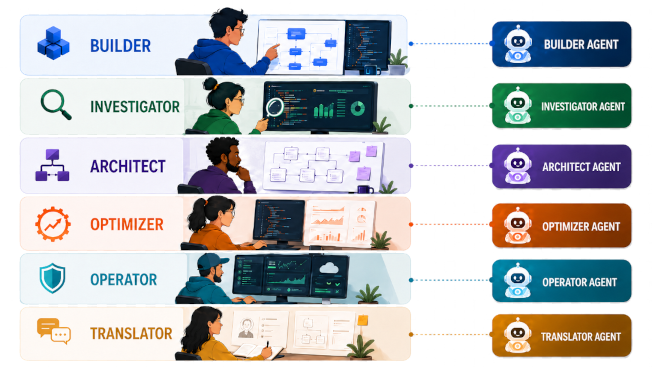
These patterns are useful for understanding human developers, but they also explain something broader about how software work is divided. In agentic coding systems, the same instincts appear in a surprisingly familiar form through agents that plan, investigate, implement, review, optimize, and operate software.
That connection becomes much more important later. For first let's begin with the humans who established the pattern and have been arguing about tabs versus spaces ever since.
Job Titles Are Not Developer Types
Before getting into the types, it is important to separate a few related ideas. Frontend, backend, mobile, database, embedded, cloud, and desktop describe technical areas. Junior, mid level, senior, staff, and principal describe some combination of experience, responsibility, organizational scope, and how many meetings someone is expected to attend without visibly aging.
C#, Python, Rust, Java, Go, and JavaScript describe the languages someone uses to create bugs.
Developer types describe something different:
A developer type is the approach someone naturally takes when presented with a problem
When a new feature request arrives, what is their first instinct? When something breaks, where do they look first? What kind of work gives them energy, and what does “finished” mean to them?
Those questions tell you much more about how a developer operates than the logo printed on their favorite programming language T-shirt.
Developer Type and Working Mode
There is another distinction that significantly affects how developers operate: whether they primarily work as part of a team or predominantly work alone.
Team Developers
Independent Developers
This should not be treated as another developer type. It is better understood as a second axis. A developer has a Problem Solving Type and a Working Mode. The Type describes how the person naturally approaches a problem, while the Working Mode describes the environment in which they normally solve it.
Someone might therefore be a Team Builder, an Independent Investigator, a Team Architect, or an Independent Operator. A developer might also be a Team Translator with strong Builder tendencies or an Independent Builder who turns into an Investigator whenever something catches fire.
A Builder working on a large product team may be responsible for one feature inside an established architecture. A Builder working alone may be responsible for the feature, database, interface, deployment, support, documentation, permissions, and the backup that has apparently not run since February.
Both are Builders. Their day-to-day reality is just very different.
This distinction is also present in agentic coding systems. Some coding agents receive a complete, bounded task and work independently, while others operate as part of a coordinated group in which planning, implementation, review, testing, and operations are assigned to separate agents.
The technology changes, but the organizational question remains familiar: should one capable worker own the entire problem, or should several specialists divide it? In other words, do we need one really smart peep, or a whole crew of peeps with clearly labeled responsibilities?
The Team Developer
A Team Developer works in an environment where software is designed, created, reviewed, deployed, and maintained by multiple people. This means they must consider more than whether their own code works. They must also consider whether another developer can understand it, whether it follows shared conventions, how it affects someone else’s work, whether it can be reviewed and tested, and who will eventually maintain it.
A technically correct solution can still be a poor team solution if nobody else can safely modify it without first performing code archaeology and a small ritual.
Team Developers gain regular exposure to other approaches. Code reviews, design discussions, shared troubleshooting, and the occasional polite disagreement over something absolutely critical, such as whether a method name should contain the word Get, all shape how they work.
The team may understand the entire system collectively even when no individual developer understands every part of it. That can be a strength, but it can also become a weakness when the one person who understands authentication goes on vacation and apparently takes the documentation, tribal knowledge, and emergency phone number with them.
The Independent Developer
An Independent Developer predominantly works alone. This includes freelancers, consultants, solo application developers, small business developers, internal developers who maintain an organization’s applications by themselves, and developers who create personal or open source projects without a regular team.
Independent does not necessarily mean isolated. They may work directly with users, managers, customers, vendors, system administrators, or occasional contributors. The difference is that most technical decisions, implementation work, and eventual consequences return to one person.
The Independent Developer may simultaneously be the developer, architect, database administrator, deployment engineer, support desk, documentation writer, security reviewer, and person who knows where the backup is stored. The official job title may say “Software Developer,” but the actual job description is usually closer to:
“Whatever the application needs today.”
Independent Developers frequently develop broad technical awareness because there is nobody nearby to hand the unfamiliar parts to. They learn enough about databases, interfaces, servers, networking, security, deployment, and business processes to keep the entire thing moving.
That breadth is valuable, but it has traditionally come with a hard limit: time.
A solo developer may know how to improve the deployment process, expand the test coverage, investigate an intermittent bug, modernize an older component, prototype a new idea, update the documentation, and finally automate that task everyone has performed manually for six years. Knowing how to do all that stuff does not magically create enough hours to actually do it.
This is where agentic coding changes the situation considerably.
For the Independent Developer, agentic coding can provide something they may never have had before:
A development team.
Not necessarily a human team, and certainly not a team that can operate without supervision, but a collection of specialized workers that can investigate, prototype, implement, test, review, document, and operate in parallel or in sequence.
The Independent Developer can assign one agent to inspect an unfamiliar portion of the codebase while another creates a prototype. A separate agent can generate tests, another can review the implementation, and another can examine deployment or operational concerns. The developer remains responsible for direction and judgment but no longer has to personally perform every intermediate step in a strictly serial order.
This can multiply what one person is capable of attempting. Work that repeatedly remained at the bottom of the list because there was never enough time becomes much more approachable:
- Prototyping stuff
- Testing stuff
- Debugging stuff
- Shipping stuff
- Managing and maintaining stuff
- Administering stuff
- Documenting the stuff nobody documented the first time
- Cleaning up that other stuff everyone agreed to “circle back to”
In highly technical terms:
“Yo dawg, you can finally do more of that stuff you never had time to do, because your AI agents can help with the other stuff.”
The real advantage is not simply that an agent can type code faster. The advantage is that the Independent Developer can divide work into roles that previously existed only inside their own head.
They can ask a Investigator agent to understand the problem before an Architect agent proposes a solution. A Builder agent can implement it while another agent acts as a reviewer. An Optimizer can examine the workflow, and a Operator can consider how the result will be deployed, monitored, backed up, or reversed if it goes sideways.
Wait. Earlier I said this was “certainly not a team that can operate without supervision,” but what if even some of that supervision can be delegated to another agent?
Well, it can.
Reread the previous paragraph and replace “the Independent Developer” with “the Orchestrator agent” or, depending on how formal your agent architecture documentation needs to be, the HMFIC agent.
The Orchestrator can assign the Investigator agent to understand the problem, ask the Architect agent to propose a solution, direct the Builder agent to implement it, send the result to a reviewer, and then involve the Optimizer or Operator when their perspectives are needed. It can track progress, pass context between agents, reject incomplete results, and loop failed reviews back to the agent responsible for fixing them.
Instead of personally supervising every individual agent, the Independent Developer primarily supervises the Orchestrator. The Orchestrator supervises the team.
You supervise the supervisor.
BOOM.
Who Architects the Architect?
There is another slightly uncomfortable distinction worth making here.
Agentic coding can give the Independent Developer the team they never had, and an Orchestrator agent can assume much of the work involved in coordinating that team. However, somebody still has to design the Orchestrator, define its authority, choose its specialists, establish its review loops, and decide how it recognizes success, failure, or the classic “technically completed but completely missed the point.”
In other words, somebody must architect the Architect.
This is where developer type begins to matter in a more consequential way.
Every developer type can benefit from agentic coding, but not every type will find the design of an agentic system equally natural. Using an agent to perform a bounded task is one skill. Designing a system that decomposes work, distributes context, coordinates specialists, evaluates output, handles failure, and decides when human intervention is necessary is another.
That work strongly favors architectural thinking.
The Architect, particularly the System Designer, is naturally inclined to think about boundaries, responsibilities, interfaces, dependencies, and how separate components work together. The Translator helps ensure that the system is solving the correct problem. The Investigator defines how results will be questioned and verified. The Operator considers permissions, containment, observability, rollback, and recovery. The Optimizer improves routing, context use, repetition, and the efficiency of the overall workflow.
The Builder remains essential but may experience more friction at this level. A Builder’s natural instinct is to start producing. An agent architect must often delay production long enough to define how production will be directed, checked, rejected, corrected, and eventually trusted.
This is particularly true of the Prototyper. Prototypers can create impressive agent demonstrations quickly, but a demonstration and a dependable agentic system are not the same thing. The first proves that agents can do something. The second proves they can do it repeatedly, within boundaries, while producing results another person can evaluate and maintain.
One is a cool demo.
The other is something you might actually let near payroll.
That does not mean Builders cannot design agentic systems, nor does it make Architects inherently better developers. It means the work rewards different instincts.
A Builder may thrive when using an established agent architecture to prototype and ship software at remarkable speed. An Architect may thrive while designing the system that allows several Builders, being human, artificial, or both, to work coherently. An Investigator may be the peep who discovers why the entire arrangement fails only after the Orchestrator delegates two related tasks at the same time and both agents decide to rename the same interface differently.
Different types remain valuable. They are simply not interchangeable.
Agentic coding lowers the amount of labor required to create software, but it does not lower the amount of judgment required to direct that labor well. AI can provide the team you never had, but somebody still has to design the team, assign the work, recognize weak results, and notice when the entire group is confidently marching toward the wrong destination while generating beautifully formatted progress reports.
Some developers will find that work deeply natural. Others will find it exhausting, overly abstract, or frustratingly indirect.
That is not necessarily a personal failure. It may simply mean they belong in a different part of the system.
The practical lesson is not that only Architects should use agentic coding. It is that developers should understand which layer suits them. Some will thrive while designing Orchestrators, review loops, and teams of specialized agents. Others will thrive when those systems give them the freedom to build, investigate, optimize, operate, or translate at a scale they could never reach alone.
The mistake is not being the “wrong” type. The mistake is assuming every type is naturally suited to every layer of the work because somebody on the internet said anyone can become anything if they buy the right course.
The Independent Developer is no longer forced to perform every role at the same moment. They may not even need to directly coordinate every role at the same moment. Their responsibility moves one level higher: defining the objective, setting the boundaries, reviewing important decisions, and making sure the entire agent team remains pointed at the correct problem.
That does not eliminate the developer’s responsibility. Agent generated work still needs direction, boundaries, verification, and judgment. A team of agents can increase capacity, but it can also generate incorrect code, duplicate effort, misunderstand requirements, or confidently create six different solutions to the wrong problem.
The goal is not to remove the Independent Developer from the process. It is to move them toward the role they were already performing informally: directing the work, deciding what matters, reviewing the results, and maintaining a coherent understanding of the whole system.
In that sense, agentic coding does not make the Independent Developer less independent. It gives them the team they never had while allowing them to remain the person who understands why the software exists and how all the pieces fit together.
This may be one of the most significant advantages agentic coding offers. A large organization can use agents to expand an existing team, but an Independent Developer can use them to create capabilities that previously required a team in the first place.
For a lot of solo peeps, that difference is huge.
Most Developers Are a Combination
Very few developers fit completely into one type. A developer may primarily be a Builder but have strong Investigator tendencies. Another may be an Architect who becomes an Operator whenever production is involved. Somebody else may be a Translator at work and an Optimizer while spending six hours configuring Neovim to save four keystrokes.
That last one is completely reasonable, by the way.
Working mode is not always permanent either. A developer may work on a large team professionally while maintaining personal projects alone. Another may spend ten years as the only developer in an organization before joining a formal software team and discovering that pull requests are not personal attacks.
The goal is not to place everyone into a perfectly labeled container. Developers generally resist containers unless Docker is involved.
A useful classification usually identifies four things:
- A primary problem solving type
- A secondary problem solving type
- A predominant working mode
- A weak or underdeveloped approach
That creates a useful picture without dividing humanity into 147 increasingly specific subclasses and making everyone update their LinkedIn headline.
With that in mind, I think most developers can be grouped into six broad types.
The Builder
The Builder wants to make something work. Give Builders a feature request and their first thought is usually:
“Let me start putting this together.”
They enjoy turning ideas into functioning software. They like visible progress, working screens, completed endpoints, and features users can actually touch. Builders are often at their best when the problem is understood and somebody needs to convert it into reality.
They are usually less interested in discussing the theoretical elegance of a button than they are in making the button do what it is supposed to do.
This is also the role most people imagine when they think about an AI coding agent: give it a request and have it produce code. As with human Builders, however, generating the implementation is only one part of producing software that is correct, maintainable, and genuinely useful.
A Builder agent that produces 4,000 lines of code in ninety seconds is impressive right up until somebody asks whether any of it should exist.
Builder Sub-Types
The Prototyper
The Prototyper is fast. They can take a vague idea and turn it into something demonstrable before the meeting discussing the idea has officially ended.
This is valuable during experimentation and early development because a prototype gives everyone something real to react to instead of debating imaginary software for three weeks. The danger is that prototypes sometimes escape containment and become production systems.
Six years later, somebody discovers that the company’s primary financial application is still running on a database named test2finalREAL.
Nobody knows what happened to test1.
Nobody wants to ask.
The Finisher
The Finisher enjoys taking work from mostly complete to actually complete. They handle validation, edge cases, cleanup, user feedback, and the dozen small details separating “it works on my machine” from “people can safely use this.”
Finishers are valuable because starting software is exciting, while finishing software often involves error messages, documentation, empty states, permissions, accessibility, deployment details, and discovering that users can paste an entire novel into the First Name field.
The Finisher is the peep who notices that the shiny new feature has no loading state, no error handling, no documentation, and no plan for what happens when the API returns null.
The Builder on a Team
A Team Builder usually creates one part of a larger system. They must work within existing interfaces, coding standards, architecture, release schedules, and decisions made by people who may no longer work there.
Their strength is producing momentum inside a coordinated environment. A strong Team Builder understands that finishing their code is not the same as finishing the feature. The work must integrate with other components, survive review, pass testing, and avoid causing three other developers to spend the afternoon resolving merge conflicts.
Team Builders benefit from having Architects, Investigators, Operators, and Translators around them. Those people can help define the boundaries while the Builder concentrates on implementation. Their blind spot is assuming that somebody else is handling everything outside their assigned portion.
Sometimes somebody is.
Sometimes everybody thought somebody was.
The Builder Working Alone
An Independent Builder usually owns the entire path from idea to implementation. They can make decisions quickly because they do not need approval from a committee, architecture board, product owner, and whichever department controls the button colors.
This freedom can make Independent Builders extremely productive, but it can also encourage them to begin coding before fully understanding the problem because nobody is present to ask inconvenient questions.
Independent Builders must learn to temporarily switch into other types. They must become the Translator long enough to understand the user, the Architect long enough to choose a structure, and the Operator long enough to deploy the result safely. Otherwise, they may build exactly what was requested, only to discover that what was requested was not what was needed.
Agentic coding can amplify both sides of the Builder. A well directed agent team can help an Independent Builder prototype and ship at a speed that previously required several people. A poorly directed team can help that same Builder produce the wrong thing faster, in more files, with excellent documentation and a very confident summary.
Builder Strengths and Blind Spots
Builders create momentum. They help teams and organizations avoid analysis paralysis and turn plans into usable software.
Their weakness is that they can begin implementation before the problem is fully understood. In teams, this may produce code that does not fit the larger system. When working alone, it may produce a complete application that solves the wrong problem beautifully.
Sometimes the Builder needs somebody to say, “Hold up, y’all. What are we actually building?”
The Investigator
The Investigator wants to understand what is actually happening. When something breaks, the Investigator does not immediately start changing code. They reproduce the issue, inspect logs, trace execution paths, compare environments, and begin asking suspiciously specific questions.
Investigators are the developers you want nearby when the application fails only on one computer, every third Tuesday, after the user prints a PDF and rotates their monitor.
The same distinction matters in agentic coding. An agent that generates code is useful, but an agent that examines an unfamiliar codebase, traces an error, compares evidence, and explains the cause is performing a different kind of work. Calling both of them “coding agents” hides an important difference.
One writes stuff. The other figures out why the stuff is on fire.
Investigator Sub-Types
The Debugger
The Debugger works methodically. They isolate variables, create reproducible tests, inspect state, add logging, and follow evidence instead of randomly changing settings until the error becomes frightened and leaves.
A good Debugger does not merely fix the immediate problem. They explain why it happened.
A great Debugger also leaves enough evidence behind that the next peep does not have to rediscover the entire mystery from scratch.
The Code Archaeologist
The Code Archaeologist specializes in older or unfamiliar systems. They can enter a codebase with no documentation, unclear naming, abandoned frameworks, and comments written by somebody who left the organization during the previous presidential administration.
Instead of immediately declaring that everything must be rewritten, they begin uncovering how the system actually works. Code Archaeologists understand that strange code frequently exists for a reason.
Sometimes it is a bad reason.
Sometimes the reason is terrifying.
Sometimes the reason is “Steve said this was temporary in 2011.”
But there is usually a reason.
The Investigator on a Team
A Team Investigator can use the combined knowledge of several people. They can ask who last changed a component, compare observations across environments, divide an incident into separate areas, and challenge another developer’s assumptions.
This makes team investigation powerful when it is coordinated well. It can also produce a group debugging session where six people watch one person share a terminal while everyone offers increasingly creative theories.
Strong Team Investigators document what they discover. They do not keep the solution trapped inside a chat thread or inside the memory of the person who happened to fix it.
Their blind spot is allowing the investigation to become fragmented. One person examines the database, another examines the network, and another examines the code, but nobody assembles the findings into one explanation.
Everybody has a clue.
Nobody has the murder board.
The Investigator Working Alone
An Independent Investigator has complete freedom to follow the evidence wherever it leads. They are often highly resourceful because they cannot immediately ask the database team, networking team, application team, or vendor specialist.
They are all of those teams.
The weakness is the absence of another person to challenge assumptions. A solo developer can spend hours investigating an advanced theory while overlooking a configuration file directly in front of them.
Independent Investigators benefit from creating written hypotheses, using reproducible tests, and occasionally explaining the problem aloud. Their rubber duck may eventually be promoted to senior developer.
Agentic coding gives the Independent Investigator several additional sets of eyes. One agent can examine logs, another can trace recent changes, another can inspect configuration, and a reviewer can compare their conclusions.
This does not guarantee the correct answer, but it is considerably better than arguing with yourself in four terminal windows while the production system continues making concerning noises.
Investigator Strengths and Blind Spots
Investigators reduce guessing. They identify root causes and help prevent the same failure from returning under a slightly different name.
Their weakness is that they can continue researching after enough information exists to make a decision. Eventually, somebody has to stop examining the footprints and catch the bear.
When working alone, the Investigator must recognize that moment personally. On a team, somebody else will usually schedule a meeting about it.
The Architect
The Architect wants the pieces to fit together correctly. When a new feature is proposed, the Architect starts thinking about boundaries, dependencies, data flow, maintainability, security, and how the decision will affect the system three years from now.
Architects naturally zoom out. Where the Builder sees a feature, the Architect sees the feature’s relationship with everything around it, three downstream systems, two future integrations, and a security concern nobody else noticed.
Agentic coding makes the need for this role obvious. An implementation agent can produce locally reasonable code while unintentionally working against the larger system. Whether the Architect is human or artificial, somebody/something must preserve the boundaries, assumptions, and direction of the whole application.
Otherwise, every agent becomes the mayor of its own little code neighborhood.
Architect Sub-Types
The System Designer
The System Designer thinks in components and interactions. They consider APIs, services, databases, integrations, authentication, deployment boundaries, and failure points.
They are usually the person drawing boxes and arrows while everybody else slowly realizes the “small feature” now involves four systems, an external vendor, and a certificate that expires every eighteen months for no obvious reason.
System Designers are also naturally suited to architecting agent teams. They can reason about which agents should exist, what each agent is allowed to know, how work moves between them, where review occurs, and which decisions require escalation.
They understand that an Orchestrator is not just “the main chatbot.”
It is the peep responsible for keeping all the other peeps from wandering into traffic.
The Code Gardener
The Code Gardener focuses more closely on internal structure. They care about naming, organization, patterns, abstractions, consistency, testability, and making the codebase easier for the next developer to understand.
They remove duplication, improve confusing interfaces, and prevent the application from slowly becoming a bowl of spaghetti wearing unit tests as a decorative hat.
In an agentic system, the Code Gardener may also define the conventions that keep several agents from each introducing their own interpretation of “clean architecture” into different corners of the same application.
Without that role, one agent creates repositories, another creates managers, another creates services, and a fourth introduces a message bus because it read an article.
The Architect on a Team
A Team Architect must do more than produce a sound design. They must communicate it clearly enough that several developers can implement it consistently.
This requires diagrams, written decisions, examples, boundaries, and sometimes compromise. The most elegant architecture is not useful if nobody understands it or if it requires every developer to consult a 90 page design document before adding a checkbox.
Team Architects must also listen. The developers implementing the system often discover constraints that were not visible in the original design. A good Architect adjusts when the evidence changes.
A poor one points toward the diagram and insists reality has failed to comply with it.
The Architect Working Alone
An Independent Architect can make structural decisions quickly because they do not need to convince a room full of people that one pattern is better than another.
This can create a clean and coherent application because one person holds the entire design in their head. It can also create a deeply personalized system that makes sense only to its creator.
Independent Architects must deliberately document decisions and favor understandable structures over clever ones. They also need to resist designing for every possible future.
A five-user internal application does not necessarily need the architecture of an international banking platform.
Sometimes a table really can just be a table, y’all.
Agentic coding gives the Independent Architect considerable reach. They can design the system, delegate implementation, assign separate reviews, and use agents to inspect whether the final code remains faithful to the original architecture.
This is one of the types most likely to thrive when moving from “using a coding agent” to “designing an agentic coding system.”
Architect Strengths and Blind Spots
Architects provide structure and reduce long term chaos. They help ensure that today’s solution does not automatically become tomorrow’s emergency rewrite.
Their weakness is designing for possibilities that may never happen. On teams, this creates complexity everyone must carry. Working alone, it creates complexity one person must build, test, deploy, understand, and eventually apologize to themselves for.
The Optimizer
The Optimizer looks at something that already works and asks:
“Can this work better?”
“Better” might mean faster, simpler, cheaper, clearer, or easier to repeat. Optimizers notice friction. Slow builds bother them, repetitive steps bother them, and unnecessary complexity bothers them.
Clicking the same seven buttons every morning may bother them enough to create a script, a terminal interface, three aliases, a GitHub repository, and a README explaining why the rest of y’all were doing it wrong.
AI assisted development gives the Optimizer a broader surface to improve. The Optimizer may not write the feature itself, but may refine prompts, context loading processes, tool selection, model routing, token usage, or review loops so every other participant can work more effectively.
Optimizer Sub-Types
The Performance Tuner
The Performance Tuner focuses on execution. They analyze response times, memory usage, database queries, network calls, caching, concurrency, and resource consumption.
A Performance Tuner can discover that an application is making 4,000 database queries to display twelve records and somehow explain this without visibly crying.
In an agentic workflow, the Performance Tuner may also identify that three agents are independently reading the same repository, generating nearly identical analyses, and consuming enough tokens to produce a small Victorian novel.
The Workflow Simplifier
The Workflow Simplifier improves how development work gets done. They create scripts, aliases, templates, generators, shared configurations, automated checks, and development environments that reduce repetitive effort.
These are often the developers responsible for turning a twelve step setup document into:
./setup.shOf course, setup.sh may contain 600 lines, summon three containers, install a certificate, generate two configuration files, and restart a service nobody knew existed.
But that is its business.
The Workflow Simplifier is also naturally suited to building agent handoffs, reusable prompts, context packages, routing rules, automated reviews, and the loops that allow an Orchestrator to return failed work to the correct agent.
These peeps look at a five-agent workflow and immediately ask why two of the agents are doing the same thing.
The Optimizer on a Team
A Team Optimizer can create enormous leverage. Saving one developer five minutes is mildly useful, but saving twenty developers five minutes every day becomes meaningful very quickly.
Team Optimizers improve build systems, deployment pipelines, test execution, local setup, shared tooling, and application performance. Their challenge is remembering that shared optimizations must remain understandable and supportable.
A personal shell alias can be mysterious.
A build pipeline used by the entire organization should not require its creator to join every troubleshooting call like some kind of automation shaman.
Team Optimizers must also avoid improving one metric while making everyone else’s work worse. A build that runs seven seconds faster is not necessarily an improvement if nobody can understand the configuration afterward.
The Optimizer Working Alone
An Independent Optimizer focuses on personal leverage. Automation allows one person to perform work that might otherwise require several people. Scripts, templates, reusable components, repeatable deployments, and agent workflows can dramatically expand what a solo developer can manage.
This is especially useful because Independent Developers constantly switch between roles. Reducing repetitive work leaves more time for actual development.
The blind spot is that optimization can become its own project. A developer can spend an entire afternoon automating a task that takes thirty seconds and occurs twice per year.
This may still be worthwhile if they learned something.
That is the official explanation, anyway.
Optimizer Strengths and Blind Spots
Optimizers remove friction and multiply effectiveness. On teams, they improve shared systems. Working alone, they increase personal capacity.
Their weakness is losing sight of whether the improvement matters. The fastest process is not automatically the most useful process, particularly when optimizing it delayed the product by three weeks.
Sometimes the process is slow because it is bad.
Sometimes nobody actually needed the process.
The Operator
The Operator thinks about what happens after the code is written. How will it be deployed, configured, monitored, backed up, and recovered? Can the deployment be repeated? Where are the logs? Who has access? Why is the production password stored in a text file named passwords-do-not-delete.txt?
Operators understand that software is not finished when it compiles. It is finished when it can run reliably in the environment where people actually use it.
This is especially important when coding agents can modify files, execute commands, provision infrastructure, or interact with production systems. Giving an agent the ability to act without assigning an Operator’s concern for boundaries, observability, rollback, and recovery is less like hiring a developer and more like giving a power tool to an extremely confident intern.
The intern has read the manual.
The intern has not understood fear.
Operator Sub-Types
The Automator
The Automator focuses on repeatable processes. They build deployment pipelines, infrastructure scripts, environment configurations, backup procedures, and automated operational tasks.
Their goal is to replace undocumented rituals with processes the computer can perform consistently. Computers are excellent at repeating instructions. Humans are excellent at forgetting step seven and then swearing step seven was never in the documentation.
In an agentic system, the Automator may define which commands agents can execute, how environments are created, when tests run, how changes are committed, and what must happen before anything is allowed near production.
The Reliability-Minded Developer
The Reliability Minded Developer thinks about failure before failure arrives. They care about monitoring, logging, backups, graceful degradation, recovery, security, and meaningful error handling.
While everybody else celebrates that the new service works, this developer asks what happens when the database becomes unavailable at 2:13 a.m.
Nobody enjoys that question.
Everybody appreciates that person being involved when 2:13 a.m. arrives.
The Reliability Minded Developer is also likely to ask what happens when the Orchestrator misunderstands the assignment, when two agents modify the same file, when a reviewer approves incorrect code, or when an agent successfully performs a destructive command it was technically authorized to run.
That last one is how you end up explaining to management that the AI did exactly what it was told.
The Operator on a Team
A Team Operator works within shared environments and divided responsibilities. They may coordinate with infrastructure teams, security teams, database administrators, support staff, and other developers.
Their value comes from connecting those groups and making operational expectations part of development rather than an unpleasant surprise at deployment time.
The risk is that operational ownership becomes fragmented. Developers assume the infrastructure team is monitoring the service, while the infrastructure team assumes the application team configured the alerts. The application fails quietly while both groups confidently believe the other has received an email.
Strong Team Operators make ownership explicit.
They are the peeps who ask, “Who exactly gets paged when this breaks?” and refuse to accept “somebody” as an answer.
The Operator Working Alone
An Independent Operator owns the entire consequence chain. When production fails, the development team, operations team, escalation team, and emergency contact may all have the same phone number.
This encourages practical thinking. Independent Operators often understand the complete path from source code to running application because they personally configured it. They also face a greater risk of creating fragile systems that depend on their availability.
A deployment process that only works when one person performs several remembered steps is not automation.
It is choreography.
Independent Operators should prioritize repeatable deployment, monitoring, backups, recovery instructions, and documentation somebody else could follow during an emergency. Even a solo developer should design systems as though another person may someday need to understand them, because eventually future them will.
Future them is usually tired, confused, and surprisingly judgmental.
Agentic coding gives this developer additional operational capacity, but it also increases the importance of controls. An agent can check logs, test backups, update dependencies, inspect configurations, and prepare deployment plans.
It should not be allowed to improvise a disaster recovery exercise against the live database because its prompt said to “verify everything.”
Operator Strengths and Blind Spots
Operators make software deployable, observable, supportable, and recoverable.
Their weakness is resisting changes that introduce uncertainty, even when those changes offer meaningful benefits. Reliability matters, but avoiding all risk eventually becomes another kind of risk.
At some point, y’all do have to ship something.
The Translator
The Translator connects technical work with people. They want to understand what users, managers, customers, or other developers are actually trying to accomplish.
When given a feature request, the Translator does not immediately accept the wording of the request. They begin asking what outcome is needed. A user may ask for a button when what they really need is a notification. A manager may ask for a dashboard when what they really need is one weekly number.
Somebody may request an AI powered blockchain microservice when what they really need is a searchable list.
The Translator helps uncover that difference.
The Translator is one of the most important roles in agentic development. AI systems are regularly asked to act on vague requests, incomplete assumptions, and terminology that means different things to different people.
Before an agent can build the right thing, something must determine what “the right thing” actually is.
Otherwise, the agent will confidently build exactly what was typed, which is not always the same thing as what was meant.
Translator Sub-Types
The Product-Minded Developer
The Product Minded Developer thinks about user value. They consider workflows, usability, business rules, priorities, and whether the feature will actually improve anything.
They are not merely asking whether the team can build something. They are asking whether it should be built and what the simplest version might be that still solves the problem.
In an agentic system, this type may define the objective, clarify acceptance criteria, reject technically impressive work that does not help the user, and prevent five specialized agents from spending the afternoon optimizing a feature nobody needs.
That last part alone may save the organization thousands of dollars and one extremely polished dashboard.
The Teacher
The Teacher makes technical information understandable. They write documentation, explain decisions, mentor other developers, create examples, and translate complicated systems into useful mental models.
A good Teacher does not prove how intelligent they are by making something sound complicated. They prove they understand it by making it sound simple.
The Teacher can also shape how agents explain their decisions, document their work, hand context to another agent, and produce results a human reviewer can evaluate without reconstructing the entire reasoning process from Git diffs, terminal output, and optimism.
The Translator on a Team
A Team Translator works between groups. They may connect developers with users, managers, designers, infrastructure teams, vendors, or other technical specialists.
They help prevent the common situation in which every group believes it agreed to the same thing while imagining completely different results.
Team Translators are also valuable inside technical discussions. They can restate an Architect’s design in practical terms, explain an Operator’s concern to a Builder, or help an Investigator communicate why the “simple fix” is not actually simple.
Their blind spot is allowing communication to replace action. At some point, the shared understanding must become working software.
Eventually, somebody has to stop adding comments to the ticket and touch the code.
The Translator Working Alone
An Independent Translator often works directly with the person requesting the software. There may be no product manager, business analyst, project manager, or user experience team between the developer and the user.
This provides direct access to the actual problem, but it also means the developer must gather requirements, manage expectations, identify contradictions, and decide which requests should not be implemented exactly as stated.
Independent Translators must learn to explain technical limits without hiding behind jargon. They must also protect themselves from becoming a human feature request queue. Direct access to users is valuable, but every suggestion does not automatically belong in the application.
Sometimes the most useful development decision is:
“No, but here is a simpler way to solve the underlying problem.”
Agentic coding can give the Independent Translator implementation capacity they may never have had. Once the desired outcome is clear, agents can prototype alternatives, compare approaches, test assumptions, and build the selected solution while the developer remains focused on whether the system is solving the correct human problem.
That is a huge shift for peeps who have always understood what needed to be built but never had enough time or hands to build all of it.
Translator Strengths and Blind Spots
Translators reduce misunderstanding and align software with actual needs.
Their weakness is continuing to discuss possibilities when a direct decision is needed. Sometimes the team understands the problem and somebody simply needs to pick a direction and start typing.
Or assign a Builder agent to start typing.
What About Specialists?
A Specialist has deep knowledge in a particular technology or domain. They might specialize in databases, security, accessibility, graphics, networking, compilers, machine learning, or some ancient enterprise platform held together by XML and contractual obligation.
I do not consider Specialist a separate developer type, however. Specialization describes depth of knowledge, the six types describe how that knowledge is applied, and working mode describes the environment in which it is applied.
A database specialist might be a Team Architect designing shared data systems, an Independent Investigator diagnosing database problems for clients, a Team Optimizer tuning queries across a large product, or an Independent Operator maintaining a complete business application.
These are separate dimensions. A developer can be highly specialized while working alone, just as a developer can be a broad generalist inside a team.
The same is true of agents. A database agent, security agent, or testing agent describes a domain specialization. It may still behave primarily as an Investigator, Builder, Operator, or Optimizer within that domain.
Just calling something a “security agent” does not tell you whether it investigates security issues, fixes them, monitors them, explains them, or loudly declares everything insecure and refuses to continue.
How to Identify Your Developer Type
Think about the last few technical problems you worked on. What did you do first? Which part did you enjoy most? Which part did you avoid, and what did you consider “done”?
You can also look at the question you naturally ask when a new project begins:
- Builder asks, “What can I start making”
- Investigator asks, “What is actually happening?”
- Architect asks, “Where does this belong?”
- Optimizer asks, “Can this be simpler or faster?”
- Operator asks, “How will this run and recover?”
- Translator asks, “What problem are we really solving?”
Your first question will probably point toward your primary type, while the question you ask next may reveal your secondary type.
Then consider your working mode. Do you normally solve problems through shared ownership, review, and specialization, or do most technical decisions and consequences eventually return to you?
Neither answer is better. It simply changes how your strengths and weaknesses are likely to appear.
You should also consider which layer of agentic coding feels natural to you. Do you enjoy asking an agent to produce working software, or are you more interested in designing how several agents divide work, exchange context, review results, and recover from failure?
Both are valuable. They are not the same activity. One is using the team. The other is deciding who is on the team, who reports to whom, what they are allowed to touch, and what happens when one of them becomes extremely confident about a terrible idea.
Good Teams Need Multiple Types
A team made entirely of Builders may create features rapidly but accumulate structural and operational problems. A team made entirely of Architects may produce beautiful diagrams and a project scheduled to begin construction sometime after the sun burns out.
A team of Investigators may understand every possible risk but struggle to move forward. A team of Optimizers may build the world’s fastest development pipeline for a product that has not shipped. A team of Operators may create an incredibly reliable system nobody needed, while a team of Translators may hold excellent discussions about users while the repository remains suspiciously unchanged.
Strong teams combine these approaches. The Translator helps identify the right problem, the Architect gives the solution a sensible structure, the Builder turns it into working software, the Investigator determines why part of it does not work, the Optimizer improves the rough spots, and the Operator makes sure it can survive outside the development environment.
That does not always require six different people. One person may cover several approaches, especially on a small team. What matters is recognizing when an approach is missing.
The same balance applies to an AI development team. A collection of six agents that all enthusiastically generate code is not truly a specialized multi agent system. It is a group project in which everybody volunteered for the same task. Useful specialization exists when one agent plans, another investigates, another builds, another reviews, and somebody remains responsible for deciding whether the result actually solved the requested problem.
Otherwise, y’all do not have a team. You have six Builders sharing a token budget.
Independent Developers Need the Same Types
A developer working alone does not escape the need for these approaches. They must move between them, translating before building, architecting before the application becomes difficult to change, investigating instead of guessing, optimizing enough to keep the workload manageable, and operating whatever they deploy.
This does not mean every solo project needs a formal architecture review, a product committee, and a weekly meeting attended by the same person six times. It means Independent Developers need deliberate moments where they change perspective.
A useful question is:
“Which type would challenge what I am about to do?”
Before implementing a feature, think like the Translator. Before creating another service, think like the Architect. Before changing five settings, think like the Investigator. Before manually repeating the same process for the twentieth time, think like the Optimizer. Before deploying on Friday afternoon, think like the Operator.
Agentic coding allows many of these perspectives to be assigned to specialized agents. The Independent Developer does not have to perfectly perform every role, but they still need enough understanding to select the role, evaluate its work, and recognize when another perspective is missing.
AI gives you more hands. It does not automatically give you better judgment.
Moving Between Team and Independent Development
Developers who move between these environments often discover skills they did not know they were missing.
An Independent Developer joining a Team may need to adjust to code reviews, shared conventions, divided ownership, formal planning, slower decision making, and technical choices that require agreement. Their first reaction may be, “I could have finished this yesterday.” They may be correct, but finishing one task quickly is not the only concern when twelve people must safely maintain the result.
A Team Developer moving into Independent Work may need to adjust to making decisions without consensus, working outside a narrow specialty, creating systems from the beginning, handling deployment and operations, communicating directly with users, and accepting full responsibility for technical choices.
Their first reaction may be, “Who handles the infrastructure?” The answer may be waiting for them in the mirror.
Both transitions can produce stronger developers. Team Developers benefit from occasionally owning a complete feature or project from beginning to end, while Independent Developers benefit from code review, pair programming, open source participation, technical communities, or simply asking another developer to question their assumptions.
Agentic coding can partially bridge both environments. A Team Developer can use agents to gain broader ownership of a problem, while an Independent Developer can use them to introduce specialization, review, and parallel work that would otherwise require additional people.
In other words, one group gets more reach. The other group finally gets backup.
The Best Developers Learn to Switch Types
Your natural Type is not your limitation. It is simply your default.
As developers gain experience, they usually become better at switching approaches based on the situation. A Builder learns to pause and investigate. A Investigator learns when enough evidence exists to act. An Architect learns when a simple solution is sufficient. An Optimizer learns which friction is worth removing. An Operator learns to balance reliability with experimentation, and a Translator learns when discussion needs to become implementation.
Working Mode also creates habits that must sometimes be challenged. A Team Developer learns to act independently when the problem does not require a committee, while an Independent Developer learns to seek outside perspectives when one person’s experience is not enough.
The strongest developers are not necessarily those who perfectly represent one type. They are the ones who understand their default approach, the blind spots created by it, the habits created by their working environment, and when the problem requires them to operate differently.
Human Developers often learn to switch between these roles as the situation requires. Agentic Coding Systems can divide those same perspectives across specialized agents rather than asking one model to perform every role equally well.
That is where this classification becomes more than a way of describing developers. And yes, we are finally getting to the AI part some of y’all clicked the title for.
Final Thoughts
Developers are more complicated than frontend, backend, full stack, or whatever title happens to be popular this week. The technologies we use matter, but they do not fully explain how we solve problems.
Some developers primarily build, some investigate, some design, some optimize, some operate, and some translate. Most of us do several of these things, but usually not in equal amounts.
We also develop those skills in different environments. A Team Builder and an Independent Builder share the same instinct to create, but they operate under different constraints. A Team Architect must create a design other people can understand and implement, while an Independent Architect must create a design that does not depend entirely on what is currently inside one person’s head.
A Team Investigator can draw from collective knowledge, while an Independent Investigator must create ways to challenge their own assumptions. A Team Operator coordinates responsibility across people and systems, while an Independent Operator may personally own everything from deployment to recovery.
Neither team based nor independent development is inherently superior. They simply teach different lessons. Teams teach collaboration, shared ownership, specialization, review, and communication. Independent work teaches breadth, self reliance, decisiveness, complete ownership, and the consequences of your own architectural decisions.
The most capable developers borrow from both. They can collaborate without becoming dependent on consensus, and they can work independently without assuming their perspective is the only one that matters.
A useful developer classification should therefore include at least two questions:
How does this developer naturally approach problems?
In what environment have they learned to solve them?
Somebody might be an Independent Builder–Operator, a Team Architect–Translator, a Team Investigator–Optimizer, or an Independent Translator–Builder.
These descriptions tell us more than a job title because they explain both the developer’s instinct and the environment shaping it.
Now that we have so eloquently typed software builders and repeatedly noticed that these types follow us directly into AI assisted development, we can finally acknowledge what this classification has been quietly suggesting the whole time.
The same system can be used almost directly as a blueprint for creating AI coding agents.
An Agentic Coding System can include a Builder agent to implement features, a Investigator agent to inspect the codebase and diagnose problems, a Architect agent to design solutions and preserve boundaries, an Optimizer agent to improve performance and workflow, a Operator agent to consider execution, security, rollback, and production behavior, and a Translator agent to turn a human request into clear technical requirements.
The working modes apply as well. Some agents operate independently, receiving a bounded task and returning a result. Others operate as a team, handing work between specialists, reviewing one another’s output, and coordinating through an Orchestrator.
This connection may be especially important for Independent Developers. A team based developer may experience agentic coding as additional capacity inside an organization that already has specialized roles. The Independent Developer may experience it as the arrival of the team they never had.
The Builder, Investigator, Architect, Optimizer, Operator, and Translator no longer have to exist only as perspectives one person attempts to hold simultaneously. They can become distinct agents that help the developer prototype, test, debug, ship, maintain, administer, and document more work with greater speed and consistency. The Independent Developer still owns the decisions but no longer has to personally carry every box.
At that point, the question is no longer simply:
“Which model should write the code?”
The better questions are familiar ones: Which Type should handle this problem? Which Type should review it? Should the agent work Independently or as part of a Team? Which perspective is currently missing? Who supervises the specialists, and who architects that supervisor?
In other words, this post may appear to classify human developers, but it also quietly describes an agentic software development organization chart.
Maybe the future is not one all knowing AI developer. Maybe it is a carefully assembled collection of specialized agents, each with a clear role, predictable strengths, known blind spots, and another agent assigned to review whatever the Builder confidently produced at 2:13 a.m.